Monday, March 7, 2011

A Serious Man (The Screenplay)

I'm playing a little catch-up here. This is one of last year's Oscar noms, but I still feel I should get through last year's before I can get on to this year's. In any case, A Serious Man definitely fits in with the Coen Brothers' style of really strange comedies (see Burn after Reading). It isn't so much laugh-out-loud funny, but it is so bizarre that it can't help but be charming.

Having not yet seen the movie, I'm going to stay technical here. The first thing that struck me stylistically about this screenplay (and in fact, all of the Oscar noms I've read so far) is a complete divergence from the standard code of formatting. There were no INTs or EXTs, no DAYs or NIGHTs, no CONTINUOUSes, no (V.O.)s, and above all, no (CONT'D)s. The latter intrigued me most. When a character spoke over half a page, interspersed with action, there were no additional character headers to announce the return of dialogue. It was just a steady flow throughout. On one hand, this improved flow dramatically, and I can only imagine how much space this saved (despite the script being 133 pages long). On the other hand, there were moments when I found this a bit confusing in rooms of multiple characters. Still, the technique is worth considering. To paraphrase my roommate, "Write a good script. Then worry about formatting."

I enjoyed the patterns of humorous repetition (e.g. Uncle Arthur's "Out in a minute," Sarah's "I'm going to the Hole," and Danny's endless whining about the picture quality for F Troop). These completely apathetic, self-obsessed meshuggenehs built up a delightfully awful, apathetic, self-obsessed world... and it was funny!

As with many of their films, the Coen Brothers are masters of ambiguous, unfulfilling, and debatable endings. They take, in the purest sense, a slice of life with no beginnings or conclusions, and present it for the audience to speculate on its meaning (see No Country for Old Men or aforementioned Burn after Reading). Is ambiguity the key to being nominated for an Oscar? I have as yet to see the new True Grit, but if it ends as ambiguously, there may be the answer. Good read. Check it out.

Sunday, March 6, 2011

What Every Body Is Saying (Chapters 5 and 6)

The content of these two chapters is so similar that it can easily be combined into one blog post. The point I would especially like to address is that of hiding the arms and hands, based on an experience I had last night.

I went on a dinner date, nothing serious, more of a "Hi, what sort of person are you?" kind of thing. The discomfort cues were instant and consistent, starting with the eyes, which met mine maybe ten short times over two hours of decent (to the ears) conversation. But on the topic of hands, for the duration, he kept his hands completely out of sight the entire evening, tucked down between his legs, as if he were cold. I even asked if he were cold, and he denied it. When I spoke, I expressed everything with my hands to the point I thought I was going a little overboard. When he spoke, the hands never appeared. The only time I ever saw his hands at the table were when he was lifting his sangria or his cell phone. It was clearly uncomfortable for everyone.

In the background, he had totaled his car a few days before and was seriously reconsidering his drinking habits. Though he apologized for seeming depressing at the end of the night, the contrast between his typed enthusiasm for meeting up and his physical aversion to lingering was worth noting. I've felt this level of discomfort before, but only now, having read these chapters, am I able to explain why. It's worth checking out. What do people's arms tell you?

Side note: Going to make a concentrated effort to keep my thumbs out of my pockets when I do chance to pocket my hands.

Thursday, March 3, 2011

Being John Malkovich


Alright, so I didn't have a full two and a half hours last night for one of the movies on my immediate To-Watch List, so I reached out to my 2011 To-Smite List for this one. It all counts, I promise.

In any case, I'm still trying to wrap my head around this one, no puns intended. What a strange, existential and utterly surprising movie! Frankly, I haven't seen anything this strange since the Coen Brothers' Burn after Reading. It's a very dark dramedy, utterly absurd at times and at others, just disturbing (locking your wife in a cage so you can have sex with another woman in another man's body?) Again, I'm still wrapping my head around it.

Coming from a world design perspective, I adored the system of the Malkovich portal. Throughout, I kept expecting the same old routine:
  1. Person A finds magic thing
  2. Person B doesn't believe in magic thing
  3. Person A has adventures with magic thing and tries to bring Person B into it
  4. Magic thing stops working when Person B sees it
  5. Person B is condescending asshole
  6. Person A keeps having adventures with magic thing
  7. Person A saves magic thing from greedy corporation
  8. Magic thing saves Person A's family, unites A and B, and helps an old lady cross the street before disappearing into the mists of metaphysical vaguery.
The beautiful thing about this system, however, is that the portal always works. Persons B, C, D, ad Zed believe in this portal without question. It's the manner in which the script (masterfully composed by Charlie Kaufman) literally turns attention inward from the world to focus on the psychology of self. It works very well.

There were other little twists I enjoyed throughout, the Lotti's sex-identity crisis (totally had to do a triple take to recognize Cameron Diaz in this role), Maxine's crazy trip of sex and manipulation, and Craig's descent into utter villainy. Then, of course, there is the titular star, Mr. Malkovich, who proves his extraordinary versatility as an actor as he shifts from identity to identity to the spectacular restaurant of Malkovich, a place so terrifying that one hopes no such place could ever exist.

This is a great film to watch for a late-night fix of weirdness. I give it four stars for inventiveness and just being mind-bending. I honestly hope there is no portal into my brain somewhere, for the sake of the traveler.

Wednesday, March 2, 2011

What Every Body Is Saying (Chapter 4)

Is it odd that this chapter confirms a lot of past paranoia? Take all those high school dances, for instance, when I'd start dancing with someone, then their friends would join, then they'd turn their torsos inward to form a circle that I was not meant to re-enter. Ah, those were the days...

The torso seems like the most easily readable part of the body discussed so far. If it leans away. it it turns away, if it's covered, if it's puffed or pulsing, the other person is probably uncomfortable. If he or she is doing all of the above, well, you may want to seek an exorcist. Still, this fascinates me. Like the turtle, the porcupine, or the cane toad, great care must be taken to protect that vulnerable underside from harm. There are barriers to be placed or removed to indicate a person's level of comfort in a given situation, and fortunately, these barriers, like arms crossed or a whole ton of clothing, are easy to see in civil conversation.

Since the beginning of the book, I've started to notice mirroring more when I'm in a conversation with someone else. Foot brushing has become clearer, eye contact/aversion as well. What I wish would be discussed in this or a later book, however, is how to go about addressing perceived signs of discomfort. When someone is leaning away with arms crossed, what then? How does one diffuse the bomb? It's entirely possible that this will be discussed in a future chapter, so I'll wait and see.

Tuesday, March 1, 2011

What Every Body Is Saying (Chapter 3)

This chapter makes an extraordinary point: that legs are the most honest parts of our bodies, that they hold our tensions, emotions, and interests in their motion, position, and direction. There are a lot of neat tidbits to glean from this chapter with one slight problem. How on earth can a person tactfully observe another's legs in order to learn about their current conditions?

Navarro suggests that, in some cases, the action of the legs can influence the remainder of the body (e.g. bouncing legs lead to bouncing shoulders), and therefore, one does not need to take a furtive glance downward and risk a slap in the face, a very explicit indicator of a person's current emotional state.

I've realized, having read this chapter, that I am not only very expressive with my legs (especially at expressing impatience) but I am also completely incapable of getting this across to others. The bouncing legs, the lean away, the pointing toward the escape route... None of these, even when intentional, have any manner of effect on my roommate, for instance, who (bless her) can talk. Two hours of leaning away tends to lead to less bouncy legs; that much is certain.

On the opposite side of things, Navarro mentions that foot touching can be a sign of intimacy, in addition to leaning toward each other, which explains why so many people apologize to me if one of their feet so much as brushes one of mine at a table. Heaven forbid there be some form of footsies going down at lunch! This is, nonetheless, a fascinating idea, that the legs contain the honesty. If I can get away with it, I may spend more time leg watching. Of course, I may need to learn from my lunchtime friends and master the apology before attempting it.

Saturday, February 12, 2011

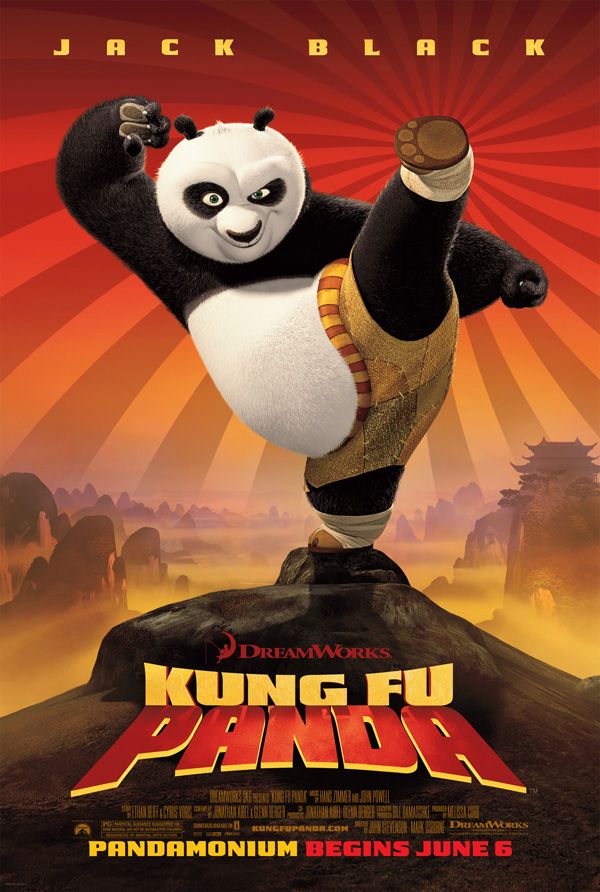
Kung Fu Panda

I could watch this movie again and again. I haven't had so much nonstop fun watching a movie in a long while. Jack Black has a tendency to get a little extreme in some of his roles, but in this case, he really brought Po, the fanboy panda, to life.

The set design in Kung Fu Panda is strikingly beautiful. The monastery, high in the hills (a la the karsts of the Li River) is surrounded by peach trees, which can magically blossom and bear fruit at the same time. The moments that the characters share near these trees are not only poetically beautiful (Master Oogway vanishing into the petals), but they are also inspiring. "...no matter what you do, that seed will grow to be a peach tree. You may wish for an apple or an orange, but you will get a peach."

Actually, lessons such as this provided the backbone of my enjoyment of this movie. Even though "the past is history, the future is a mystery, but today is a gift; that is why it is called the present," is hardly innovative, I am considering putting a big banner across my wall that reads "The Scroll Is Blank."

Kung Fu Panda gets a solid four stars, maybe four and a half. It's a lot of fun, and I'm actually looking forward to the sequel, due out this summer.

Wednesday, February 9, 2011

Scott Pilgrim vs. The World


My comic geek buddy told me this was one disappointing movie. Not having read the comic, I took his word for it, but on recommendation from my brother, I decided, what the hey, I'll give it a shot. What I discovered was a much richer experience than I could have anticipated.

I should address, first and foremost, the 8-bit video game style that pervades the entire film. I mentioned in my response to Coraline that I wasn't too keen how it devolved into a video game and would rather play the game than watch a movie try to be a video game. The difference with Scott Pilgrim vs. The World is that the style fits the genre. It is a comedy geared toward the comic book and video game fan base. That allowed me to forego the question of how the characters got their superhuman combat moves and focus instead on what the story had to tell me.

I expected this to be a fairly brainless tale of a band geek and some fights, and for the most part, I didn't really relate to Scott until the tail end of Act 2 struck a chord. The plot of the story, that Scott has to face the seven evil exes of the girl of his dreams in order to win her heart, is beautifully told. Yes, I said beautifully. This isn't just a story about Scott having to fight off a bunch of goons so a girl will like him. This is an account of how a young man must conquer a young woman's past hurt and her future doubts. In so doing, he learns to overcome himself and his own. In understanding Ramona's scars, how she sees him as another potential evil ex, Scott discovers how to take responsibility for himself. He confesses to his own jilted ex, Knives, that he cheated on her and is thus able to work with her to defeat the final ex.

***SPOILER ALERT***

Still, I consider the most poignant moment to be when Scott faces himself, literally: NEGA SCOTT. The great surprise, which doesn't work for a lot of people expecting a glorious final clash, is that he and his negative just "shoot the shit." They get along. They are at peace. This really resonated with me as I work on making peace with my own NEGA KYLE, and it demonstrated a profound sense of maturity, cleverly disguised in a film marketed toward more (with all due respect) immature audiences.

I give Scott Pilgrim vs. The World four stars, because it was difficult to really connect until the end, but it was a great ride and surprisingly meaningful. I can only hope someone in the future will have the guts to handle my own list of evil exes. I'm honing my skills to reciprocate.