Showing posts with label to watch. Show all posts

Monday, June 27, 2011

Riding Alone for Thousands of Miles

Once in a while, a film stirs you. It cuts right through the daily charade and reopens your heart to a sense of human goodness. I have just sat paralyzed through the entire credit reel of Riding Alone for Thousands of Miles, trying to process the beauty of it. So much of how I gauge what I watch comes from aesthetics and technique, but the beauty of this piece is in its humanity.

I'll try to summarize without making it too technical. Mr. Takata's son, who has been estranged for ten years, is dying. All that's left to learn about him is in a tape of a masked opera in China. At the end, the son promises the singer to return in a year to film Riding Alone for Thousands of Miles. Mr. Takata makes the sudden decision to fulfill his son's promise.

This is truly a film of masks beyond just what is on stage. Mr. Takata is in an extraordinary amount of pain throughout, but he is too afraid to show it. He hides his tears when they show and envies the singer he has sought for breaking down in tears on stage and admitting he misses his own son. Though he is convinced this journey is the only thing that can heal his relationship with his son, he discovers that all he had to do was exactly that which he fears: taking off his stoic mask and showing his son how he feels.

To describe the ending would dull its poignancy. The feelings of love and loyalty are overwhelming and not in a disingenuous way. It is a film designed for feeling, for reassessing values, and for remembering how much we are blessed with the people in our lives. I give it five stars. To say more in print would cheapen it. It should be experienced before being read.

Sunday, June 26, 2011

Y Tu Mamá También

There is a joke called "The Aristocrats." It reminds me of this film.

At the core of Y Tu Mamá También is the theme of freedom: sexual freedom, marital freedom, financial freedom, freedom to do with one's body whatever the hell one wants with whatever the hell one can find. It is the sexual odyssey of two privileged, crass, and hormonal teens, who see themselves as utterly free, yet know nothing of true freedom.

Tenoch and Julio come from wealthy families and have no problem affording all the women and marijuana they can consume. Their worlds are defined by their testosterone-laden bullshit. It allows them to drive right past the poverty, the corruption, and the culture surrounding them, keeping quiet about the truly important things. It required narration to interrupt their shallow prattle at unexpected moments to inform us of the truly important things happening in the lives of all involved (e.g. the doom of Chuy's home and career as a fisherman, the stories behind the crosses on the side of the road, etc.). The two friends do not connect on this sort of level, nor do they want to, having based their entire friendship on a mondegreen manifesto while screwing each other's girlfriends. They are the sex, drugs, and rock-and-roll, the bread and circuses that the average moviegoer craves. They believe they are free, but they are hamstrung by their inability to connect over anything but sex, which is the lesson Luisa tries, with debatable success, to teach them.

I loved the mystery of Luisa's character. Already a fan of Maribel Verdú's performance in Pan's Labyrinth, I was engrossed by her role as the woman searching for her final freedom. She is the one who can appreciate the unmentionable, who can connect with the quiet. She sees herself in the little stuffed mice and the vast ocean where we finally lose her. These are the things she tries to share with her two young companions and her adulterous husband por teléfono, but her words seem to fall on earless heads, her experiences lost among the sheets.

By the end, we are left with the question of whether their journey with Luisa has changed Tenoch and Julio. They remain crass and appear to have continued their conquests, but they are subdued, turning ever so hesitantly toward their futures in Economics and Biology, Julio's small beard growth even indicating a certain visual maturity. However, without their former sexual energy, they no longer have anything to say. They admit their hollowness, and thus their bonds are broken.

To look at this film shallowly is to be offended by the human body itself. There are few mysteries to the character's bodies by the end, yet the sexual exchanges are done tastefully, even elegantly. That's all that really matters, right? Four stars for inciting wonder and reminding me that freedom is in expression, in interest, in celebration of life. It reminds me what is to be missed with eyes down and in rather than out and up.

Tuesday, May 10, 2011

Who's Afraid of Virginia Woolf?

About a year and a half ago, I adopted two zebra finches named George and Martha. I did not really understand why they were so named other than a vague recollection of a play by Edward Albee with characters sharing nomenclature. It wasn't until I brought them home that first, Martha went after George, flying at him, pushing him out of their gourd home, pecking him, and generally being a harridan. They fought like cockerels and screwed like field mice, yet they never did produce an egg. One day, the tables turned, and George took ownership of the bird house. George began to rip out Martha's feathers. George banished Martha to the floor to pick her sustenance from among the shit-encrusted scraps on the cage floor. Then, one day, while I was away, Martha died of mysterious circumstances. I buried her under a cactus; within two days, something had dug her up and eaten her.

My only exposure to Who's Afraid of Virginia Woolf? came from mentions and a high school performance of Martha's opening monologue: I thought it was a pure comedy. What I got were two hours of pure, inhuman nastiness, goaded on by razor-sharp tongues dripping with venom. True, there were laughs to be had, but as in the life of finches, the story of a crumbled and fruitless marriage is rife with tragedy and delusion that permeates every character. There is little room for sympathy with these characters, who fluctuate so readily from fondness to loathing and back again. Nonetheless, their exchanges, much wittier and allowing more time than most modern films (owing to the theatrical source material), keep the viewer engrossed and cringing.

The late, great Elizabeth Taylor very much deserved her Oscar for her role as Martha, a performance unlike any I'd expected from the queen of class, so elegant in her horridness, yet overflowing with emotional layers that may or may not have been real to the character. Martha is a truly sick woman who has built up an entire world of illusion that George has somehow tolerated for years. Yet, they feed off each other, enable each other, and are clearly meant for each other, as dysfunctional as their alcohol- and revenge-driven relationship is. Their example offers a warning to anyone on the brink of marriage: choose wisely, not for money or out of panic, or else become the monster or the monster's bitch.

I give Who's Afraid of Virginia Woolf? four stars for sheer cringe factor. Whether I would watch it again on screen or choose to see it on stage instead remains to be determined. In any case, it is an excellent film for any (would-be) actor looking to see how the pros can make the most of long conversations in few, select settings, as well as how to effectively make the audience squirm at every turn.

Monday, May 9, 2011

Avatar (The Screenplay)

For someone constantly striving to hone world building skills, there are certain resources that tower above the others in terms of usefulness. Up near the top, with a respectful nod to Tolkien of course, is Avatar, the highest grossing film in cinematic history and the stimulus of a 3D renaissance. It has been praised for its visual genius and mocked as a cheesy version of "Dances with Smurfs," but its success and the fact that it has spawned so much dialogue is extraordinary, especially as a science fiction film taking place in a world that is not our own, a genre that traditionally caters to a niche market. The true magic of Avatar rises from its visual elements, but in order to spawn such breathtaking cinematography, the foundation had to first be laid in print. Examining this foundation has been very enlightening, and even inspiring, on the following levels.

The world of Pandora shares much in common with Earth in that there are plants and animals, which interact with each other in a systematic and occasionally predatory way. However, on a cinematic level, these worlds differ fundamentally, starting with lighting. Unlike the planet, Earth, Pandora is a moon, orbiting around a gas giant, which provides most of the planet's lighting through reflection. Pandora's ecosystem then compensates for the lack of light through ubiquitous bioluminescence, the element which contributes most successfully to the dreamlike nature of the world. Additionally, the lower gravity of this moon and the presence of "unobtanium" in the soil, have permitted massive growth among the fauna and flora, further diminishing the importance of puny humanity and thus turning the dream world into a nightmare.

A note on unobtanium: the film doesn't really clarify what "unobtanium" really does or why it's worth so much to humanity. The name "unobtanium" sounds ridiculous, and so it seems a haphazardly planted element in an otherwise elegant world. The screenplay describes it as a magnetic material producing a maglev (magnetic levitation) effect, designating it as an important raw material for anti-gravity technology, something understandably useful to space-age humanity. However, there is one brilliant aspect to this omission in the film, which is all but impossible to see on screen. On page 30, Grace picks up a copy of Dr. Seuss' The Lorax from a school desk, an act of little to no significance in a quick camera shot. However, the central conflict of The Lorax, which was initially banned from television, comes from the destruction of the Truffula trees to produce Thneeds, which have no function at all but are in high demand. Thus, by omitting the use of unobtanium, the filmmakers have created a useless MacGuffin, for which the greedy are willing to destroy anything, making their actions even more barbaric to the viewer.

Conversely, there were quite a few thematic elements to the screenplay that enriched the reading experience but felt sadly lost in the viewing. The first instance comes from the distinction between the human connection to machines, one of distance and utility (e.g. Quaritch's controlled Wushu kata while hooked up to an ampsuit), and the Na'vi connection to the creatures they ride, one of intimacy and brotherhood (e.g. linking up to the banshees, which then bond to their riders for life). The contrast between these two relationship styles serves to highlight a rapid social retreat from personal intimacy in favor of the mechanical, which is easier to discard. We can see this in the futuristic Earth, all but destroyed and littered with what has been discarded (like Jake), a way of life that the colonists of Pandora believe will serve them well on all worlds. Therefore, we have the cultural conflicts of destruction/disdain and life/respect, a theme addressed in the film but more succinctly described in the script.

The allure of the Na'vi culture and the negative effects of the conquering human worldview on Jake's psyche come across much more clearly in the screenplay than in the film. Jake comes from this cold, hostile world of machines and people, but it is on Pandora, among an alien culture of respect and intimacy, that he is able to find his humanity. It is literally drawn out of him and absorbed into a new body to the point that he is more human as an alien than he ever was among other humans. His transformation thus invites the viewer to question the limits of his or her own humanity, though it's doubtful how many viewers left the theater questioning their human natures.

Thematic elements can be dreadfully difficult to visualize without inserting bad lines of exposition, so I make no judgment there. However, the creation of this world with its vast zoological population required a lot of exposition, the technique of which I badly want to learn. James Cameron (who, for some reason, just can't fit into one name like "Spielberg") introduces his menagerie of alien creatures in a dual manner: in the scene descriptions, they are known by Mendelian Greek names (e.g. leonopteryx), while the characters in the film refer to them exclusively by their Na'vi nomenclature (e.g. toruk). This makes it easier for the reader to keep track of creatures without spending unnecessary time trying to pronounce the names, while on screen, the viewer has a visual guide to the creature and thus does not care what it's called anyway. The writing sets up this visual guide simply, focusing on one or two specific traits: teeth, leg count, colors, crests, horns, what Earth animal it might represent, and what Earth animal it could rip apart. The characters then add details of the creatures' ecological importance (human) or cultural importance (Na'vi). In the end, it only takes us a few lines to understand each creature's role in the world and to let it be absorbed into the backdrop without forgetting what it is when it returns later.

The combined script and film are rich in detail, though the latter unfortunately takes a turn toward the cliché through ad libbing. Nonetheless, the details of this world drive the whopping 152-page screenplay and three-hour film in the form of smaller adventures and simple moments of awe at the bioluminescence, the floating mountains, or the wonders of flight. The world provides conflicts and lessons aplenty, leaving us no chance to be bored and only a little opportunity to be confused. The Avatar screenplay is a great reference for creating a world that is not only spectacular and innovative but also relatable.

Monday, May 2, 2011

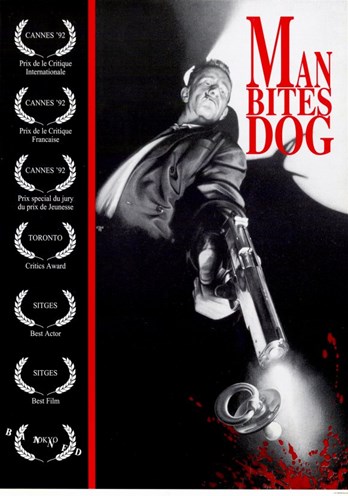
Man Bites Dog

I had a bit of trouble watching this film, and unfortunately, my only reason was technical. My internet sputtered and died about twenty minutes from the end of it, following the film's main motif of sputtering death. I have a problem with the Netflix classification of all genres of film made outside the country as "Foreign." When I think "Foreign," I think artsy, cultural, and tragic. In many ways, Man Bites Dog (or more appropriately, C'est Arrivé a Chez Vous) has elements of art, culture, and tragedy, considering it's shot documentary-style long before that became the hip thing to do for action movies. The premise is that a documentary film crew, having decided to film the life of a serial killer, gradually gets pulled into the murders themselves, but I would argue, they were more than willing participants from the beginning.

After watching this film, I'm reminded of a story my television instructor told the class during Sophomore year of high school, how when she worked at a local news station, there was an incident of a child drowning in the river. She recounted that the cameras arrived on scene and began thrusting their microphones into the face of the mother who was weeping over the body of her child. It was too much for her, and she recalled her crew. The crew featured in Man Bites Dog takes this kind of inhumanity a whole step further. They smile and congratulate the killer, Benoit, for his kills, and when one of their own goes down, they pick up his gear and keep filming. There is no love here. There is no humanity. That which is seen on the camera, even if it's happening inches away, is unreal and therefore entertaining.

I came into this film with a bias toward a very different serial killer, Dexter, who has a code of punishing much worse offenders who have slipped through the clutches of the law. I could attempt to understand a film crew being sympathetic toward someone with a code like that, but Benoit Patard is no Dexter Morgan. He kills for the pleasure of it and for the money. He is creative in his killings, rewatching them like a football coach reviews plays to see how he could improve it. What's especially shocking is how careless he is, murdering in public places in broad daylight, yelling, shooting, and making a scene. Yet, because he has a television crew following him everywhere, all the people he meets and murders trust him completely, letting him into their homes, letting him lead them away. He kills lots of people, elderly and children included, but the crew just keeps on following him, no matter how much he insults or berates them, doing everything he asks with big, goofy grins on their faces. It is the effect of stardom, of losing oneself in one's craft.

While I did wonder about the pervasive lack of suspicion or police presence, even the idea that a serial killer would want the kind of liability a film crew would present, my greater wonder came from what Man Bites Dog had to say about the rest of us. Do the horrible murders we witness affect us? Maybe, maybe not. Would they affect us more if we were there filming? Is life slowly becoming indistinguishable from the lens, or is there hope that if we should find ourselves witnessing real atrocity, that we would feel, question, resist? At what point do we go from being apathetic to condoning the actions we see on the tube, if not externally, then internally? Do we need violence to hold our attention anymore?

In terms of watchability, this was not as gruesome as I half expected, considering the last French crime film I started to watch (and did not get past five minutes) was Irreversible. Benoit started as a charming, humorous person, then decayed very quickly, really bringing the viewer's awareness to the ugliness that is now so ubiquitously entertaining. I have to give it four stars for innovation, entertainment, and the provocation of thought. It's worth a look.

Sunday, May 1, 2011

Dr. Strangelove

As a huge Peter Sellers fan, I came into this movie with high expectations. I grew up on the Pink Panther movies, and even to this day, they continue to prompt uproarious laughter. The man was a genius, and combined with the genius of Stanley Kubrick, I figured the genius would be overflowing, the laughs unstoppable. In short, there was a lot of genius, and plenty of tongue-in-cheek content, but almost no laughs at all.

Make no mistake, the acting was brilliant. I had to do a triple take to realize that Sellers was playing all three main characters, a set of performances pulled off so well as to rightfully deserve the nods of the Academy, especially as the president, whose straightforward approach contrasted heavily with Sellers' more flamboyant roles (see A Shot in the Dark or Murder by Death), yet was actually one of the funniest in the film. Nonetheless, considering his mad, titular character only showed up in two scenes, I felt a lot like I did watching the original Pink Panther, the first in the Clouseau series, a bit bored and let down.

Humor aside, the brilliance of the film resides in its critique of the military chain of command, especially the question of what happens when a link in that chain gets rusty. The theme also appears in another of Kubrick's more famous works, Paths of Glory, which deals with the need for a scapegoat and the inability of the lower echelons to prevent their superiors from executing innocent men. These themes serve as reminders that joining the military is not a foolproof path to glory, as the scenes of Americans following orders to shoot other Americans demonstrate.

All in all, in terms of whether I would watch Dr. Strangelove again, I have to give it three stars. It dragged at times, and I was underwhelmed by the brand of humor, which may have been too consistently subtle for my taste or perhaps, dated.

Monday, April 25, 2011

Watchmen

In pondering Watchmen, I think I will have the same problem as the directors in adapting Alan Moore's masterpiece to the screen: there is so much to talk about that it simply cannot fit. I entered it with the bias that Moore refused to be affiliated with the film, that the film was long and at times, boring. Nonetheless, it is a fragment of the world of superheroes that must be explored if one is to show any sophistication in the subject, because sophistication, or more appropriately, reflection, is the essence of the Watchmen.

The story demands that the audience look at the grander picture, which explains the nearly three-hour run time and the seemingly endless exposition. I enjoyed the character development, the stories that gave us depth without forcing us into thrills and spills. I enjoyed Dr. Manhattan's existential battles (Is anything really worth saving?). My enjoyment lasted until around midpoint, where the script woke up and realized it hadn't given us a plot to follow. It was a slice of life script for superheroes, which, in the end, wasn't satisfying. There were great moments, to be sure: Rorschach's stint in prison, the flashbacks to the awfulness of the Comedian, and Dr. Manhattan's fortress on Mars.

However, as befitting Ozymandias, the smartest man in the world, the film was 90% intellect and 10% the filmmakers trying to fill the rest of the space. That ninety percent encompasses how much the question of why humanity should be saved was actually answered. The ten percent encompasses the swiftly fading elegance of the last half. In short, when we cut to the many screens of news coverage with no tears, no reactions, just a sea of calm, practical faces, when the final scene is of a bored newspaper company only worried about finding new material, I was left to wonder whether anyone truly believed that the death of millions of people would be a calamity. The Silk Spectre's circular argument on the matter (humanity should be saved because millions of people will die) did not help.

Despite my quarrels with the balance of intellect versus heart in the film, I thoroughly enjoyed a good portion of it. It presented superheroes stripped down and (minus Dr. Manhattan) without the distractions of high-powered battles. The conclusion reminds us that we humans now make our own gods, and they, in the form of atomic energy, keep us from tearing each other apart on the greater scale. If only this film could affect us as significantly on the smaller scale, it would be a masterpiece of cinema to rival the masterpiece of graphic literature. For now, three stars.

Saturday, April 16, 2011

Metropolis

I'm not going to lie. It's really difficult for me to get into German expressionism, especially after a long day at the beach. When Metropolis opened with the disclaimer that large chunks of the film had been lost to the ages, I was afraid this was going to be one erratic, haphazard two hours of movie. There were two things that I felt specifically kept it from becoming so: the artistry and the performances. While I enjoyed parts of the score, there were times where even it became a bit too repetitive; therefore, I'll keep my focus on the other two.

The city design of Metropolis, though largely limited to artists' sketches and miniatures, encompassed a grandeur, the likes of which modern civilization has yet to attain. The comparison of the city to the Tower of Babel was a tight fit. The buildings towered above the streets below, each one seeking to outdo its neighbor in height and diameter. No space was spared between them and walkways connected them; in all actuality, in this world, there was no reason for any human to set foot outdoors at all, which lent itself to the closed-minded world of the characters.

Starting out, I really did not want to like our protagonist, Freder (played by Gustav Fröhlich), whose heavy makeup and hyperbolic reactions to everything contrasted gratingly with his father's more subtle appearance. However, our love interest, Maria (Brigitte Helm) and mad inventor, Rotwang (Rudolf Klein-Rogge), both managed to outdo Freder in over-the-top expression. However, when she wasn't flailing her arms and crashing blindly into walls, Maria as the robot was a lot of fun to watch. Her bizarre erotic dance, her spiderlike hand gestures, and her sneering glances, all done with a mechanical rhythm, somehow managed to grasp perfectly the image of that which is twisted and evil in the world.

Metropolis comes from the days when a message could be hammered down the throats of the audience without receiving great scorn, but despite its continuous restating of its message, I really enjoyed the analogy of the head and hand needing to meet at the heart; it is an excellent message to take into account when working with dreamers and workers, because compassion and empathy, or at least the attempt at it, are essential to a working society, as demonstrated by the mob of workers racing from their city to destroy the machine that kept them alive, leaving their children to die. Thus, as befits truly classic science fiction, Metropolis leaves us with both a happy ending and a stern warning for the future: side with neither the hand nor the mind exclusively, but walk that delicate line between mobs or else become the problem. I give Metropolis three stars for artistry and the provoking of thought.

Thursday, March 3, 2011

Being John Malkovich


Alright, so I didn't have a full two and a half hours last night for one of the movies on my immediate To-Watch List, so I reached out to my 2011 To-Smite List for this one. It all counts, I promise.

In any case, I'm still trying to wrap my head around this one, no puns intended. What a strange, existential and utterly surprising movie! Frankly, I haven't seen anything this strange since the Coen Brothers' Burn after Reading. It's a very dark dramedy, utterly absurd at times and at others, just disturbing (locking your wife in a cage so you can have sex with another woman in another man's body?) Again, I'm still wrapping my head around it.

Coming from a world design perspective, I adored the system of the Malkovich portal. Throughout, I kept expecting the same old routine:
  1. Person A finds magic thing
  2. Person B doesn't believe in magic thing
  3. Person A has adventures with magic thing and tries to bring Person B into it
  4. Magic thing stops working when Person B sees it
  5. Person B is condescending asshole
  6. Person A keeps having adventures with magic thing
  7. Person A saves magic thing from greedy corporation
  8. Magic thing saves Person A's family, unites A and B, and helps an old lady cross the street before disappearing into the mists of metaphysical vaguery.
The beautiful thing about this system, however, is that the portal always works. Persons B, C, D, ad Zed believe in this portal without question. It's the manner in which the script (masterfully composed by Charlie Kaufman) literally turns attention inward from the world to focus on the psychology of self. It works very well.

There were other little twists I enjoyed throughout, the Lotti's sex-identity crisis (totally had to do a triple take to recognize Cameron Diaz in this role), Maxine's crazy trip of sex and manipulation, and Craig's descent into utter villainy. Then, of course, there is the titular star, Mr. Malkovich, who proves his extraordinary versatility as an actor as he shifts from identity to identity to the spectacular restaurant of Malkovich, a place so terrifying that one hopes no such place could ever exist.

This is a great film to watch for a late-night fix of weirdness. I give it four stars for inventiveness and just being mind-bending. I honestly hope there is no portal into my brain somewhere, for the sake of the traveler.

Saturday, February 12, 2011

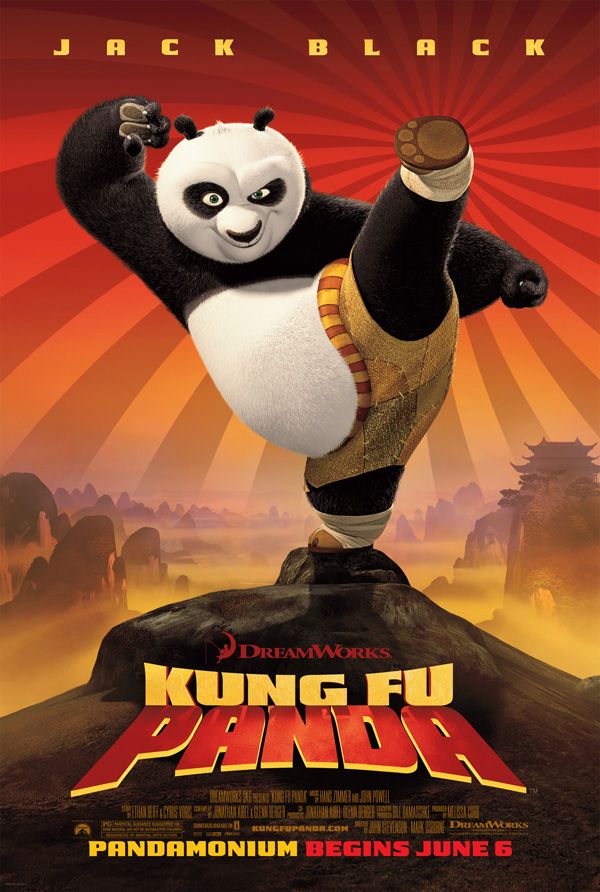
Kung Fu Panda

I could watch this movie again and again. I haven't had so much nonstop fun watching a movie in a long while. Jack Black has a tendency to get a little extreme in some of his roles, but in this case, he really brought Po, the fanboy panda, to life.

The set design in Kung Fu Panda is strikingly beautiful. The monastery, high in the hills (a la the karsts of the Li River) is surrounded by peach trees, which can magically blossom and bear fruit at the same time. The moments that the characters share near these trees are not only poetically beautiful (Master Oogway vanishing into the petals), but they are also inspiring. "...no matter what you do, that seed will grow to be a peach tree. You may wish for an apple or an orange, but you will get a peach."

Actually, lessons such as this provided the backbone of my enjoyment of this movie. Even though "the past is history, the future is a mystery, but today is a gift; that is why it is called the present," is hardly innovative, I am considering putting a big banner across my wall that reads "The Scroll Is Blank."

Kung Fu Panda gets a solid four stars, maybe four and a half. It's a lot of fun, and I'm actually looking forward to the sequel, due out this summer.

Wednesday, February 9, 2011

Scott Pilgrim vs. The World


My comic geek buddy told me this was one disappointing movie. Not having read the comic, I took his word for it, but on recommendation from my brother, I decided, what the hey, I'll give it a shot. What I discovered was a much richer experience than I could have anticipated.

I should address, first and foremost, the 8-bit video game style that pervades the entire film. I mentioned in my response to Coraline that I wasn't too keen how it devolved into a video game and would rather play the game than watch a movie try to be a video game. The difference with Scott Pilgrim vs. The World is that the style fits the genre. It is a comedy geared toward the comic book and video game fan base. That allowed me to forego the question of how the characters got their superhuman combat moves and focus instead on what the story had to tell me.

I expected this to be a fairly brainless tale of a band geek and some fights, and for the most part, I didn't really relate to Scott until the tail end of Act 2 struck a chord. The plot of the story, that Scott has to face the seven evil exes of the girl of his dreams in order to win her heart, is beautifully told. Yes, I said beautifully. This isn't just a story about Scott having to fight off a bunch of goons so a girl will like him. This is an account of how a young man must conquer a young woman's past hurt and her future doubts. In so doing, he learns to overcome himself and his own. In understanding Ramona's scars, how she sees him as another potential evil ex, Scott discovers how to take responsibility for himself. He confesses to his own jilted ex, Knives, that he cheated on her and is thus able to work with her to defeat the final ex.

***SPOILER ALERT***

Still, I consider the most poignant moment to be when Scott faces himself, literally: NEGA SCOTT. The great surprise, which doesn't work for a lot of people expecting a glorious final clash, is that he and his negative just "shoot the shit." They get along. They are at peace. This really resonated with me as I work on making peace with my own NEGA KYLE, and it demonstrated a profound sense of maturity, cleverly disguised in a film marketed toward more (with all due respect) immature audiences.

I give Scott Pilgrim vs. The World four stars, because it was difficult to really connect until the end, but it was a great ride and surprisingly meaningful. I can only hope someone in the future will have the guts to handle my own list of evil exes. I'm honing my skills to reciprocate.

Friday, January 21, 2011

Coraline


Everything I had to say about thematics, I've already said here. Instead, I'd like to present the following for the reader's consideration:


The soundtrack is a gorgeous mix of haunting chorals and toe-tapping jazz beats that I will be adding to my collection to hear again. It really is reason enough to explore this story beyond the script.

Otherwise, in terms of the adaptation, it did sort of strike me strangely how old the characters were. I realize the script had them in their early teens, but the written story made it easier to envision the characters much younger. I didn't mesh with the voice acting at all, though I do have to give Teri Hatcher credit for shedding most of her flustered Desperate Housewives whine during her transformation into the Beldam. The ghost dialogue bothered me because it felt like video game dialogue; if I'm going to hear video game dialogue, I'd rather it be in a video game.

In terms of the visuals, I think I expected a little too much Nightmare before Christmas in terms of bright, ghostly lighting and eerie shadows, compared to the surprisingly "realistic" fantasy design of this film. Some choices I could have seen differently, but nonetheless, this was an engaging film made remarkable by its sound design. I'm sure it would have been spectacular in 3D as well. I'll give it four stars, because I'm still logged onto Youtube, listening to clips from the soundtrack.

Wednesday, January 19, 2011

Michael Clayton


It's not easy to get me to watch movies with a character's name as the title. For all I knew, Michael Clayton would be about a pottery instructor searching for meaning in his miserable life, and who hasn't seen that before? In any case, all it took was the viewing of a single scene in a film class, which sadly, happened to be the last scene, and I decided this would be a swell thriller to add to the queue.

This is an excellent example of a realistic thriller. We don't have agents or SWAT teams piling out of vans. There really aren't any guns, per se, though there is a car bomb. What we have is a talented man who has made a career as a puppet and learns just how unsatisfactory that choice is.

Since I was partly watching this for research purposes, I paid special attention to the pacing of this revelation. The prologue lasts sixteen minutes: ample time to explain the nitty gritty of the world and set up the main conflict of who would try to kill this talented individual. However, it takes an hour and twenty minutes for Michael to actually realize that the puzzle pieces aren't fitting together; the main action takes place over forty minutes. However, the rest of the duration, while slightly confusing to those of us who don't speak legalese, was hardly dull, which I attribute to the performance of the actors.

It seems to me that George Clooney is picking up a trend in his roles, that of the floating man, consumed by his career, alienated from friend and family, and undeniably talented (see Up in the Air). He carries a very similar attitude in his performance, which works well in his roles, but in this case, he was overshadowed by the truly eerie, Oscar-winning performance of Tilda Swinton, who reminded me throughout of Lucifer weeping for his inescapable corruption. Also noteworthy was Tom Wilkinson's snarling opening narration, the performance of which saved what could have been a rather dull opening montage, and his quirky portrayal of Michael's sage coworker and friend, Arthur. In my curiosity over acting, Michael Clayton stands out as an exemplary reference for natural acting.

I give Michael Clayton four stars as a valuable resource and a compelling story with memorable characters.

Saturday, January 1, 2011

Apocalypto

I found it fitting to make Apocalypto the last movie I watched in 2010. If I wanted to get rid of a full year's worth of aggression and violence, Apocalypto could channel it all away. I suppose it's fitting of its maker in that respect.

In many ways, violence defines this movie. Much of it is unnecessarily graphic and seems to be placed in there only for the sake of making the audience squirm. Nonetheless, it excels at painting a vivid image of the human nature to subdue and conquer. The Mayans understood raping and pillaging just as well as the Huns, the Romans, the British imperialists, and the American colonists. By graphically revealing the violent tendencies of a civilization often held to be the victim of outside aggression, Gibson has highlighted the fact that all civilizations have been, at some point, capable of dehumanizing others and committing atrocities. The good, therefore, lies in whomever has the courage to oppose these atrocities.

While I expected our protagonist, Jaguar Paw, to take down the entire Mayan civilization in two hours, I was satisfied that his battles stayed personal. Though he didn't take a particularly active role in most of the story, being bound to a slave pole, the world through which he traveled, more than compensated. The costume design was extraordinary. The piercings, tattoos, and fantastic feather and skeletal attire were worth every second to behold, though I snickered when I realized that the women and children were dressed according to Christian modesty. I enjoyed the prop design as well. The tapir trap made me cringe, and the ridiculous puppet jaguar made me laugh out loud. Oh wait, that wasn't supposed to happen. Nonetheless, our hero managed to survive it all, despite a soon-to-be-badly-infected set of wounds, though the arrival of the Spanish conquistadores in the final moments leaves us less than hopeful for their long-term well being.

Through the despair and violence, anyone who views the aptly named Apocalypto is compelled to sit back and take two things into mind: that there is no final solution and that there is no choice, when faced by utter destruction, but to move on. For its fantastic production design, engrossing plot, and thought-provoking elements, I'd give Apocalypto four stars.

Friday, December 31, 2010

2011 To-Smite List

I've been updating my To-Smite List weekly, but now that the year is coming to a close, it's also important to set more long-term goals. So, I'm going to set up a To-Smite List for the entire year of 2011. These are the goals that I hope to accomplish before December 31, 2011:

To Write:
HC Outline
JP
MY
M
The first three updated short stories for my website

To Read:
Agamemnon
Antigone
Avatar

An Education
Full Fairy Tale Collection (8 count)
Full Journal of Scientific Exploration
The Hurt Locker
In the Loop
The Kite Runner
The Last Station
Paradise Regained
Personal Finance for Dummies
Precious
The Road
A Serious Man
A Single Man
What Every Body Is Saying

The White Ribbon


To Watch:
8 1/2
Apocalypto
Barbershop
Being John Malkovich
Chariots of Fire
Cool Hand Luke
Coraline
The Decalogue
Dr. Strangelove
Knocked Up
Kung Fu Panda
La Terra Trema
La Vie En Rose
Louder than Bombs
Man Bites Dog
Memoirs of a Geisha
Michael Clayton
Mother
The Motorcycle Diaries
Patton
Precious
Riding Alone for Thousands of Miles
Scott Pilgrim vs. the World

Seven
Titanic
Waking Sleeping Beauty
Who's Afraid of Virginia Woolf?
Y Tu Mama Tambien?


To Build:
Language Chart
In So Many Words (Volumes 1-3)
The Little Prince (Spanish, French, and German)
Website Illustrations

To Acquire:
Flip Mino Video Camera
Tripod


To Photograph:
Calvary Cemetery
Flying Fish Festival at Catalina Island
Huntington Library and Gardens
Meditation Mount / Ojai

Salton Sea
San Miguel Island (Deferred until 2012)
Self Realization Fellowship Lake Shrine
Sequoia National Forest


To Remember:
Have fun

Thursday, December 30, 2010

The Enigma of Kaspar Hauser


This is another one of those DVDs that has been sitting in my Netflix queue since who knows when. Then I got it in the mail, and it's been sitting on my desk for a month. So, I figured it was about time to watch it, especially since I have a soft spot for Werner Herzog after Grizzly Man and Incident at Loch Ness.

The story is based off an actual occurrence, in which a 17-year old boy appeared suddenly in Nuremberg, unable to speak or even relate, having spent his entire life locked in a cellar and mysteriously released. The people of the town then do their best to integrate him into society.

Right off the bat, I was jarred by the contrast between the legend and the character. I expected a teenager and got a balding man in his forties. Fortunately, no one tried to play him off as a teenager. Despite the confusion over age and a very slow start, the performance was delightful. Kaspar's origins as a lame, grunting creature and slow transcendence to cultured philosopher would serve as a worthy challenge for any actor. While it was difficult for me to like Kaspar at first, over time he began to grow on me. I found his way of speaking most endearing, as he would wax awkwardly philosophical in everything he said (apparently, some of this dialogue was taken from letters written by the actual Kaspar Hauser).

The story moved very slowly and did not allow for any sort of attachment to the characters. Nonetheless, it engrossed me, from the children teaching him rhymes to the Four Riddles at the Carnival (was the King of Punt drugged?) to the final mysteries surrounding Kaspar's dreams and murder, which, by the way, was terrifying enough without having to see it.

I liked this film a lot more than I expected, despite the DVD glitches. It was episodic, but it felt like a nice collection of vignettes that were enjoyable enough to earn four stars.

Thursday, December 9, 2010

Kiki's Delivery Service


The description on the Netflix sleeve as "gentle" could not be more accurate in describing Kiki's Delivery Service. As a fan of Hayao Miyazaki's work, I figured it would be important to add this movie to the list, though in all honesty, it didn't live up to his other works.

Despite the story centering on a witch, there was surprisingly little magic in the movie, which in some ways helped keep the focus on Kiki's personal journey, but for a fantasy film, I just wanted more. Fairly episodic in structure, it was more of a meditation on growing up than the adventure it claims to be. The conflicts were short-lived and sometimes vague, but in many ways, that embodies those fun pre-teen years.

I could, however, relate to the idea that immersing oneself too heavily in one's work strips the magic away from life. This wasn't just a be-yourself sort of story. Kiki had a mission to which she was entirely devoted: to become a witch. However, while focusing on that one goal, she lost her joy, her best friend, and even her ability to work on her goal. In a way, the message for work-related depression is pretty somber. Nonetheless, the ending turns out happily for all, and we are left with a feel-all-right sort of movie. I'd give it three stars, just because of the director.

Sunday, November 21, 2010

Groundhog Day


Though it's nearing the end of November, I decided to take a trip to Punxsutawney, PA for Groundhog Day. To discuss Groundhog Day I should first discuss Groundhog Day. Groundhog Day is an occasion for celebration, for humans to gather together and be merry over a common occurrence, even if it just so happens to be plucking a large rodent from a burrow and asking it whether it saw its shadow. The reason isn't especially compelling to most, but it is a true glimpse of the humanity that Bill Murray's character, Phil Connors, lacks.

The beauty in Phil's voyage from bitter egoist to joyful humanist comes from his discovery of life's little details. One of the most powerful moments for me came from his "I'm a God" speech in the diner, when he reveals the back stories of all of the side characters filling the place. It made me realize that for every person in a crowd, there are stories, desires, and memories. Taking into account these details and taking the time to explore them suddenly makes the world all the richer.

On the topic of time, one of the perks to reliving the same day again and again is being able to take advantage of all the time lost to narrow-minded goals, in Phil's case, his career. When he suddenly finds himself with all the time in the world, he starts to learn the piano, ice sculpture, auto mechanics, and empathy. It made me pause to think of how much time there really is in life and how much could be gained from every initiative. The unlimited potential of any given day is not to be understated or ignored, for to do so would be a great loss.

Notwithstanding the humor, which was light-hearted but hardly laugh-out-loud, I really enjoyed Groundhog Day for the fact that it's inspired me to explore life more, take an interest in the details, and just be appreciative of each day. For this, I give it four stars.

Friday, November 19, 2010

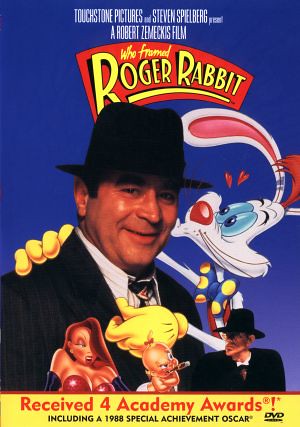
Who Framed Roger Rabbit?


It had been a while since I last saw this movie. In fact, I couldn't remember a moment out of it. Nonetheless, I decided to add it to my queue after it came up in a class on monsters and detectives several years back. I'm actually quite glad I checked it out again, because now, the richness of the world really registered with me.

The blending of animation and live action is so extraordinarily well done, from the lighting on Roger as he moves from set through the work area and out into the real world, to the real effects that Jessica's two-dimensional fingers have as they pinch Eddie Valiant's cheeks. The gags, such as the "cattle call," where a line of cows practiced their lines, felt much wittier now that a few years have passed since the last time I saw the movie.

Nonetheless, the movie was a lot darker and less funny than I remember. It felt like a genuine noir film; it was too self-aware for the cartoon bits to be funny. The only time I really laughed aloud was when Eddie encounters Mickey Mouse and Bugs Bunny in free-fall and Mickey Mouse gives a giggle before saying "You could get killed." It just seemed a strange phrase to come out of the mouse's mouth. I spent the rest of the time marvelous at how Rob Zemeckis was able to get licensing for both Disney and Warner Bros. characters.

To be sure, I love crossovers. Despite the lack of laughs, the film is a feast of cross-references and self-mockery. The Daffy-Donald Duck Duel was just glorious to watch, and well, who can say "No" to Jessica Rabbit? Honestly... As a smart film that is a lot of fun to watch, I'm giving it four stars. It's one of those movies that just has to be seen.

Happy Feet


Happy Feet has been sitting in my Netflix queue for several years now, and I could never figure out why. Baby penguin + dancing + adorable = Kyle love? Well, as part of my animation fix these past few weeks, I decided to give it a shot.

It started off cute enough, the mother and father penguin getting together, the father watching their egg through the cold winter, the father dropping it, the baby hatching with a cute lil' voice to match his cute lil' tap steps. The cute lasted approximately fifteen minutes. As soon as little Mumble (voiced by Elijah Wood) hit puberty, it was as if the cuteness had been attacked and carried off by skuas, then dropped off in the middle of the ice and left to wander, because that's just what happened, journey after journey, from the search for acceptance to the search for friendship to the search for love to the search for the aliens to the search for social reform. In short, the horse on its way to Santa Barbara takes a big ol' detour up to Fillmore.

I suppose the moment I began to get lost was in the dancing. The footsteps just didn't match the feet, and the rhythms didn't really seem to sync with anything else. While this could conceivably parallel the idea of dancing to one's own beat, it just wasn't interesting. It became all the rage among the penguins, then became blasphemous, then became conventional, then became sinful multiple times, which added to the all-around choppiness of the movie.

Happy Feet may have set out to be more epic than it should have been. Creators attempted to chop up so many quest story lines and cram them into an hour and forty minutes that what I thought was intended to be a story about acceptance and self-expression turned into a do-your-part-to-save-the-world PSA with as much subtlety as a mother penguin regurgitating fish into its youngster's mouth. While it did make me feel a little sentimental when Steve Irwin had his cameo, the jumping around from Antarctica to {Florida?} and back to Antarctica completely removed me from the story and made me feel that I'd been watching a rambling ad for WWF for the past hour and a half.

Admittedly, there were some fun parts to watch, and I quite enjoyed Mumble's childhood and everything from the elephant seals to Mumble's captivity. Because of the haphazardly thrown together material surrounding those sections, interspersed with a schizophrenic soundtrack of mish-mashed pop and R&B clips, I can only give this movie three stars. Meh to the max.